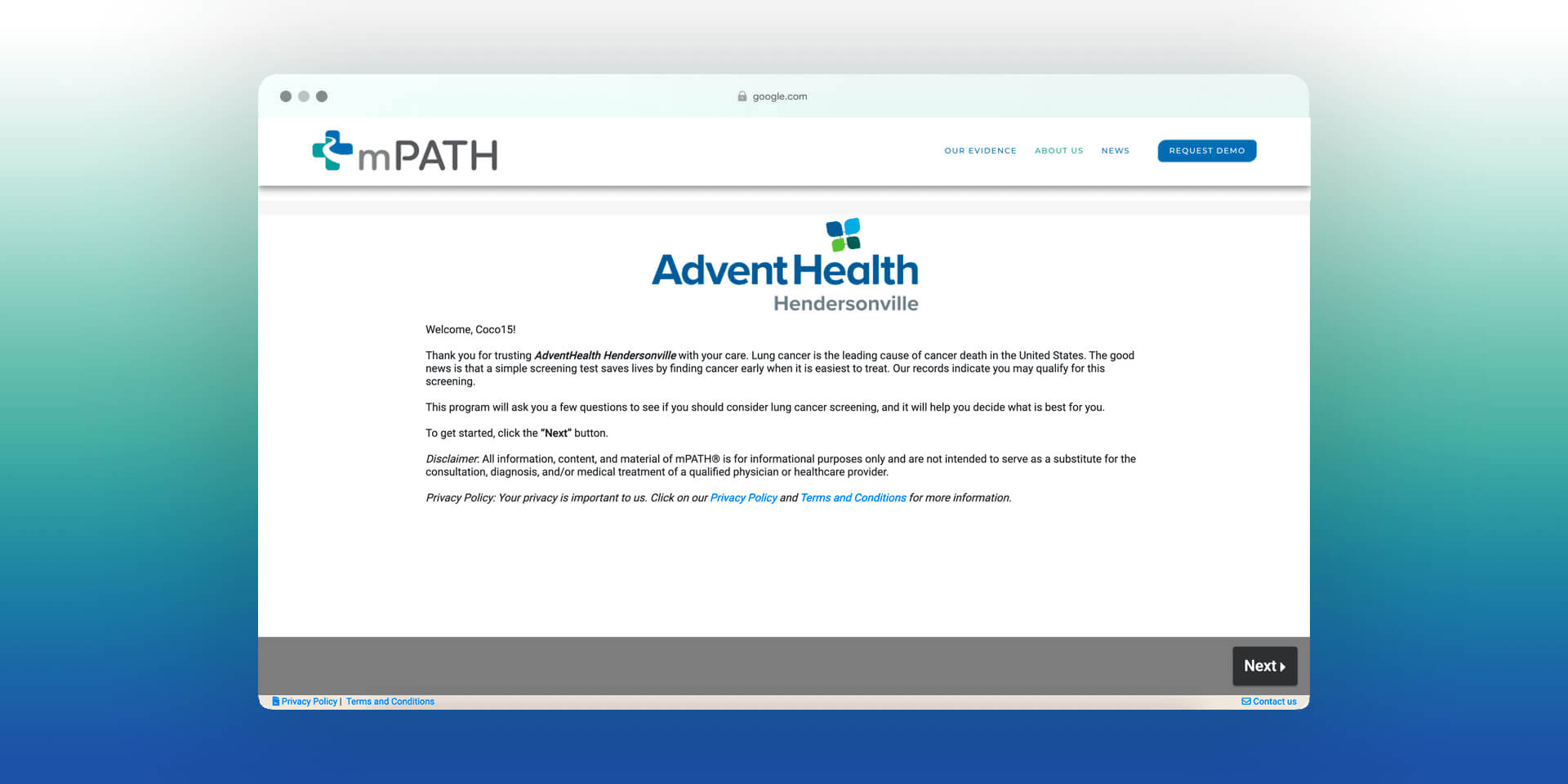
The idea for mPATH came from real-world professional experience. Both Dr. Dave Miller, co-founder and CEO, and Dr. Ajay Dharod, co-founder and CTO, had seen what happened when individuals delayed or avoided preventative screenings. As it turned out, the problem was rampant: Over 1/3 of Americans are missing out on life-saving cancer screenings. Over 90% of those who are high-risk for lung cancer – the leading cause of cancer deaths in the U.S. – are not receiving screenings for the disease. And more than 30% of Americans do not receive screenings for colorectal cancer, which is the second leading cause of cancer death.
Screenings for these diseases save lives, and yet the process to encourage those screenings has long been cumbersome and ineffective. Healthcare systems generally default to two main methods: First, they blast patient portal (“MyChart”) or text messages to patients. However, while reminders are helpful, they are often not enough to educate patients on the importance of these screenings, nor does it motivate them to take action. The second option is what Miller calls a “full-court press,” in which nurses and medical technicians are asked to call patients one by one, assess them for the screening and encourage them to schedule. This option is time-consuming and expensive, engaging key medical staff members in a laborious game of phone tag.
Both Miller and Dharod understood the potential of technology to streamline operations within the medical field and increase the impact of care. Miller has embraced computers since his first Atari 800, and before Dharod became a physician, he studied computer and electrical engineering at Clemson University. They knew technology had the power to solve the problem with missed screenings, and they used it to create mPATH.
And it worked. Miller and Dharod put mPATH through a research study funded by the National Institutes of Health, and the results were profound: When it comes to colorectal cancer, increasing screening rates by 15 to 20% is considered very successful. Miller and Dharod’s application had an increase of 100%.
From the start, the plan was always to build mPATH and then offer it to healthcare systems for free. However, when the results were published in the Annals of Internal Medicine, one of the top medical journals in the world, calls started coming in from health systems across the country. They wanted what Miller and Dharod had built.
“We realized that it’s great to say we’re going to give our application away for free, but then who will maintain and scale it? To make the kind of impact we wanted to make, we had to commercialize our business so it could develop and innovate and scale,” Dharod said.